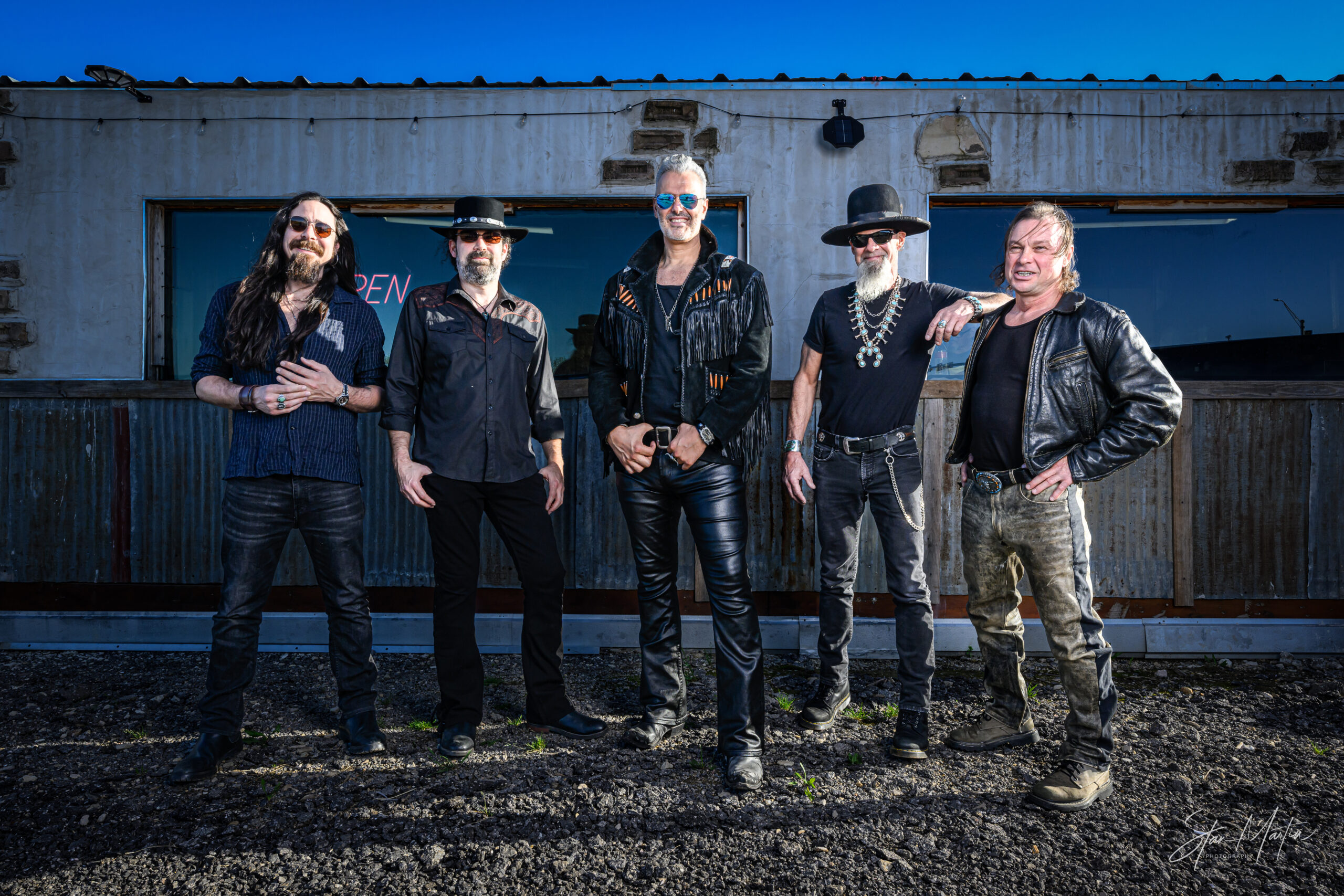
Between the green mountains of Asturias and the dusty roads of Texas, Diego Avello ‘Bull’ has built a life to the rhythm of rock. From the first chords that echoed in his native Asturias to stages in the USA, his path has been a journey of growth, transformation, and creative fire. Three studio albums, a live record, and several singles make up his discography so far, the result of years of sonic exploration and a spirit that knows no borders. To this are added several national and international tours that have led him to connect with diverse audiences, demonstrating that passion and authenticity know no language or geography.
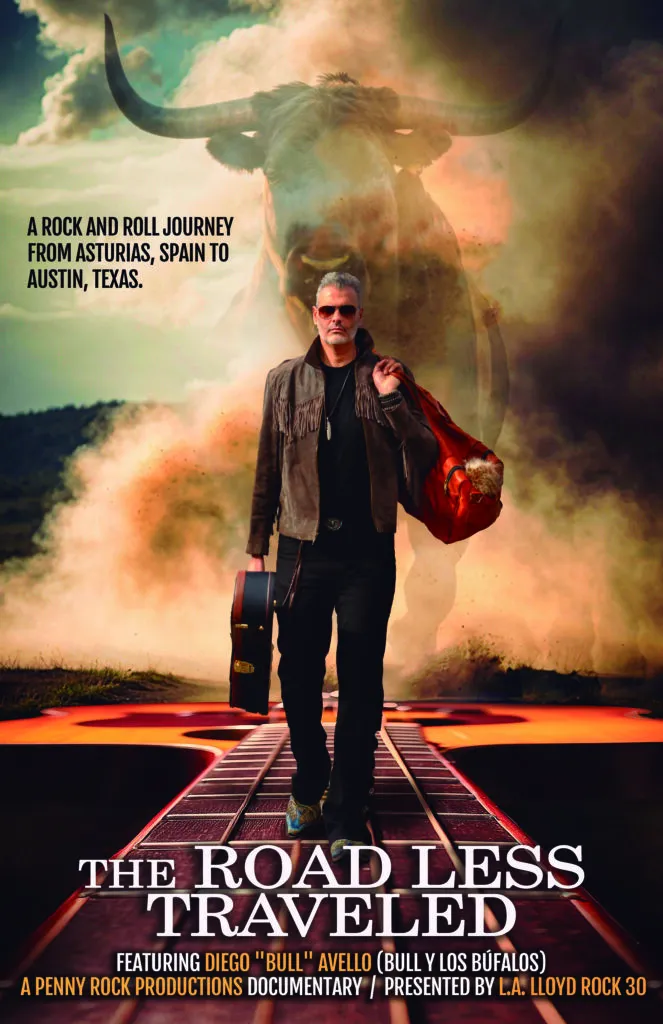
His documentary “I Took the Road Less Traveled” traces that journey: a trip of identity, faith, and sonic stubbornness. We spoke with him about memory, uprooting, internal storms, and the beauty of choosing a path that few dare to travel.
The documentary begins in Asturias, crosses Mexico, and ends in the United States. Three territories, three rhythms, three stages of the same quest.
Question: Diego, your career has been a constant journey, full of transformations and challenges. Now, with the completion in the United States of “I Took the Road Less Traveled,” your story will be shown to the world in a very intimate way. What did it mean for you to see your life and your music reflected on the big screen? What do each of those places represent for you?
Answer: Seeing part of my life and my musical career reflected in a documentary is undoubtedly an emotional journey, a mix of nostalgia, pride, and awe. You realize all the scars you’ve accumulated and also all the victories. It made me realize all that I had to leave behind: my family, my friends, and the security of my small town in Cangas del Narcea. But it also reminded me why I did it, why I took the road less traveled. Music, rock and roll, has always been my driving force and what has led me to live on all these adventures.
Asturias is the fuel, the rage of my origins. It’s where I come from and what keeps my feet on the ground. Going back there to shoot was returning to who I really am and, at the same time, facing the ghost of my youth.
Mexico was a bridge, a crucial stage of my journey that taught me to adapt, to blend in, and not to lose my identity in the process. Mexico is a very intense country with many extremes. There were some complicated and dangerous moments… but, in short, I was very lucky and I found a very generous Mexico that helped me a lot to be able to move to the USA.
The United States is the culmination of my dream, the place where I have fought and where I have managed to be accepted and, most importantly, make my way in the land where Rock and Roll was born. It represents the fruit of years of very hard work. It is the place where I have found ears for my voice and a way of life that I longed for since I was a child.
The camera of “I Took the Road Less Traveled” breathes with the same pulse as his latest single, “Divine Storm.” Both are, in a way, a self-portrait: a celebration of the chaos that drives creation.
Question: “Divine Storm” seems to be in direct dialogue with the spirit of the documentary: strength, perseverance, struggle. Is there a connection between the two projects?
Answer: Yes, totally. “Divine Storm” captures that internal struggle, that strength needed not to give up and to keep overcoming obstacles. It is the sonic manifestation of perseverance, and the documentary is the visual manifestation of those moments of doubt and difficulty, but where, despite everything, you keep pushing, crossing the storms, and fighting for what you believe in.
In Austin, director J. Budro Partida and other professionals from the film and music industry found a different energy in his story: that of a non-Anglo musician who conquers the cradle of rock with authenticity and his own accent.
Question: Your story caught the attention of audiovisual professionals in Austin, PennyRock Productions and L.A. Lloyd Rock 30, who encouraged you to tell it. What did it mean to you that others recognized your trajectory and decided to accompany you in this story?
Answer: The idea for the documentary was born from a friend who worked in the music industry, Raymond McGlamery. Unfortunately, Raymond passed away in 2022 from cancer. L.A. Lloyd (a professional at several Rock radio stations) and I had met through Raymond, and at his funeral, Lloyd proposed carrying the documentary idea forward.
During this process, the film production company “PennyRock Productions” joined the project and carried out a large part of the production and all the filming and editing of the film. I feel eternally grateful and honored that both parties wanted to tell my story! It has been almost three years of intense work and many, many sleepless hours. It signifies a recognition not only of my music but of all the sacrifice and struggle behind it. It is a reminder that if your energy is honest and brave with what you do, people will perceive it. Rock in the USA is almost a religion and undoubtedly the most powerful and demanding music market in the world, but at the same time, this country greatly respects artists, especially those who have that kind of journey in their logbook.
Singing rock in English as an Asturian means building bridges between cultures. Bull does it with honesty, without disguising his identity.
Question: The music you love was born in a very specific and culturally different context than your own. What challenges and opportunities did you find in building your musical voice in English and in a genre as iconic as rock and roll?
Answer: Well, it was not an easy road at all, haha. Rock and roll is a genre with very deep Anglo roots, and being an Asturian singing in English, with my accent and my way of singing, is not what is expected, it’s not what is in the books; in the end, I’m a foreigner singing in a foreign land. The first challenge was precisely that: the language and my accent. At first, there was insecurity, but I soon realized that my accent was not a defect but a characteristic that made me unique. Instead of trying to hide it, I decided to embrace it. Rock is, in essence, music of the street, of truth, and my accent is part of my truth.
I also had to face the need not to be labeled. Some expected me to play Latin music, but I never beat to that rhythm… I focused on telling my story, on conveying my message in the most sincere way I could, and at the rhythm I have always beaten to, and that rhythm is called Rock and Roll.
Migration not only changes where one lives but also how one feels and creates. In his music, Bull translates displacement into strength and nostalgia into movement.
Question: In what way has the experience of immigrating and living in another country influenced your way of making music and the message you want to convey with Bull y los Búfalos?
Answer: Failing far from home is a very hard blow. Each failure makes you doubt everything… When I left Cangas del Narcea, I not only left a place but also a part of who I am. It is a constant feeling of guilt for the family and friends you leave behind and, at the same time, a torrent of adventures and new tastes that keep you constantly excited. All those emotions became a form of strength and movement. It was, and continues to be, the main source of inspiration to keep going and to keep writing lyrics and music.
Being chosen as the best rock band in Texas by MXD Magazine and participating in the soundtrack of Mayans M.C. have been milestones that consolidate their presence on the scene.
Question: Bull y los Búfalos was chosen as the best rock band in Texas by the prestigious MXD Magazine. What did this recognition mean for you and the band within such a competitive country with so much musical tradition?
Answer: I’ve never believed that music is a competition or that there are better bands than others; however, receiving awards, besides feeding the ego, haha, always helps to promote your work. Beyond the trophy, the meaning for me was the validation of the struggle, the hard work, and the talent. It was a reminder that our musical stubbornness, what we call “Stubborn Rock,” was bearing fruit. At the same time, it was cultural acceptance in such an iconic genre and in such a competitive country. This award showed that our mix of American rock with a Spanish touch was not only welcome but also appreciated and recognized.
Speaking of recognition, three of your songs were part of the soundtrack for the series “Mayans M.C.,” an important milestone for any band.
Question: How did this opportunity come about, and what impact has it had on your career?
Answer: It was one of those “small-big victories!” But it was no easy task… The soundtrack for the TV series “Mayans M.C.,” like its predecessor “Sons of Anarchy,” was managed by Quentin Tarantino’s music supervisor, and I had to go through many filters to be able to contact her and send her my music. Finally, after almost a year of negotiations, they decided to use three of our songs for the second season. The impact on our career and the visibility that appearing in “Mayans M.C.” gave us was a very important point in our growth as a Rock band and for myself as a songwriter, besides the pride for an independent band that your music appears in a television series with global reach and distribution.
The journey continues. Between new songs, tour ideas, and sonic experiments, Bull looks ahead with the calm of someone who has learned to wait.
Question: After the intense journey of the documentary, what new artistic projects are you currently working on? Are there any tour plans, new albums, or musical experiments that you’re excited about?
Answer: The film has closed one chapter and, at the same time, has opened new paths that we are eager to explore.
I recently moved from Austin, Texas, to Nashville, Tennessee. Nashville has become the epicenter of the music industry in the United States, which is a key point for my plans to find a new management team and record label. Additionally, I am constantly inspired by Nashville’s musical environment and sound. Rock and roll is a genre that has always evolved, and so have we. I’m working on writing new songs, adding new flavors and influences for what could be a new album. Of course, we are always looking for new concerts and tours. Nashville is the perfect place for this new chapter!
Question: Regarding the premiere of the documentary that we all hope to see from this side of the world, do you have the date or location of its broadcast in Asturias confirmed yet? How do you imagine that special moment?
Answer: The documentary is artistically finished, but we are still working on legal matters, contracts, and permits to be able to present it publicly. However, we plan to have three private screenings in different cities: Nashville, Austin, and, of course, Cangas Del Narcea, Asturias. At the same time, this month, we have started sending the documentary to the film festival circuit, both national and international. And as for how I imagine the premiere in Asturias? Well, with a lot of cider and a lot of partying! Hahaha, after all, that’s what being Asturian is about, celebrating that we are alive, strong, and not willing to give up…
Diego Avello “Bull” chose a path that few dare to take, a road with no guarantees, no promises of applause or certainties. It is a route sprinkled with deep silences but also with small miracles: a perfect chord, a knowing look from the audience, the unwavering loyalty of a band that resists.
In his voice, that stubbornness of dreamers persists, an obstinacy that, bordering on madness, becomes the only path to authenticity. His rock, he affirms, does not seek to please but simply to exist. And in that search, in that almost spiritual clinging to sound, a true lesson in resistance is revealed.
“I Took the Road Less Traveled” is, in essence, the declaration of someone who decided to chart his own course, even if the climb was hard and the map was blank. It is the confession of a musician who chose uncertain beauty over safe comfort. And so, like a whisper that blends with the echo of a guitar fading away, the idea remains: keep playing, even when the path is the one less traveled. Or perhaps, precisely for that reason.